I just got back from Directions Asia 2026 in Ho Chi Minh City, Vietnam, and I am still processing how much happened in those few days. I had the privilege of presenting two sessions, sat in on some genuinely brilliant talks from people I respect, caught up with old colleagues, and walked away with a head full of ideas and a notebook that I am now nervous to leave anywhere.
This post is my attempt to put it all down while it is still fresh.
Partner Pre Day with Yaveon and Tasklet Factory
Before the main conference kicked off, we joined Yaveon and Tasklet for their first ever joint Partner Pre Day. It was a focused day, the right people in the room, and the kind of conversation that genuinely reflects where Business Central delivery is heading across our region.
The morning enablement session set the tone, getting partners aligned on what actually matters for delivery and industry focus in this market. The afternoon roundtable went a layer deeper into an honest question: are Asia and ANZ ready for more industry-specific solutions, and what does it actually take, commercially and technically, to make that work here? Not the polished answer you get in a deck. The real one.
A few things stood out for me. The first was the consistent push toward customer outcomes over feature lists. The strongest ISV combinations are the ones that solve real operational problems on day one, not after twelve months of customisation. The second was watching Yaveon and Tasklet work hand in hand. Two specialist ISVs that we know inside out, one bringing Food and Beverage process depth, the other bringing warehouse mobility, in a way that no single product is going to match. And the third was just a grounded read on the region. No hype, just honest talk about the commercial, technical, and market realities of taking vertical solutions to customers across Asia and ANZ, and what actually scales.

For Equerra, the day was another quiet confirmation that we are on the right track. Helping Food and Beverage and complex mid-market businesses pick the right ISV stack, get more out of Business Central, and stop reinventing what specialist partners have already solved is exactly the lane we have been in for a while now. It was great to share the room with ISVs we genuinely enjoy working with, and partners across the region pushing the same agenda. The momentum is real.
Terima kasih to Yaveon , Tasklet Factory Factory, and every partner who showed up.
The Two Sessions I Delivered
This year I had two sessions on the schedule.
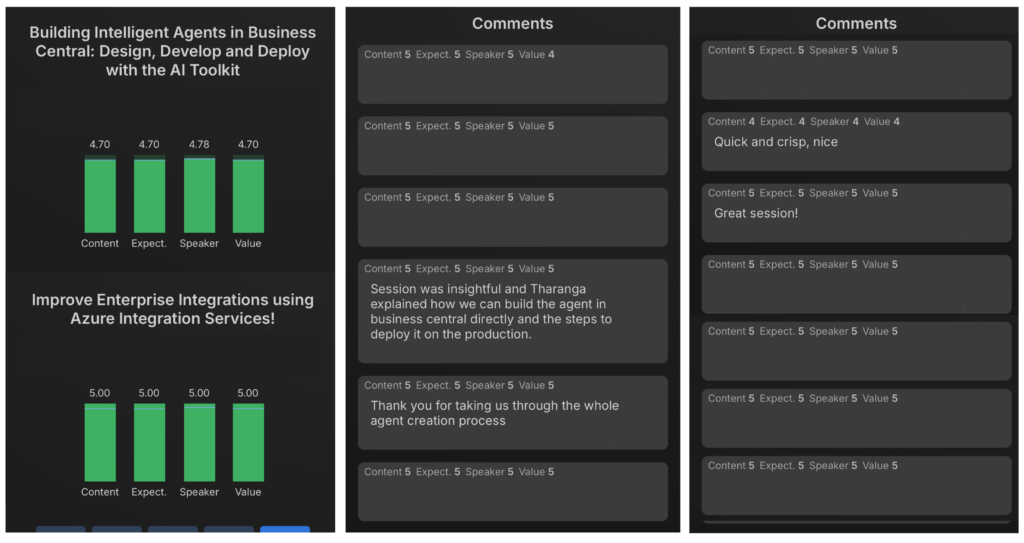
The first was Building Intelligent Agents in Business Central: Design, Develop and Deploy with the AI Toolkit, which I delivered on day two. This one zoomed in on the new Agent Building Sandbox that Microsoft released, and more importantly on the value we can add to customers as partners using it. The toolkit is genuinely exciting, but the bigger story is what it unlocks for the partner channel if we approach it the right way.
The second was Improve Enterprise Integrations using Azure Integration Services, which I co-presented with Steve Gichure. We kept it deliberately grounded. Rather than going feature by feature through every service in the Azure Integration Services stack, we focused on the basics and on how a partner can actually leverage these technologies to build decoupled, scalable solutions that hold up when demand spikes. The whole idea was to give the room something they could take back to their team on Monday morning and start applying, not a list of services to Google later.
Here is the part that surprised me most about preparing both talks. For pretty much my entire speaking career, I have delivered deep dive sessions. That is the natural instinct when you come from a developer background. You want to show the code, walk through the architecture, prove that you actually built the thing. Those sessions have their place, and I still love them.
But these two were different. Both were focused on delivery and on what we can achieve as a partner, not on technology for its own sake. It was the first time I had taken that angle on stage, and honestly, it felt like a different muscle. The reason I made the shift is simple. In the last six to eight months, the new role in Equerra and AI has changed how I work and how I approach problems, and pretending otherwise on stage would be dishonest. The conversation our industry needs right now is not another walkthrough of a codes. It is a conversation about what good delivery looks like in a world where the code itself is becoming the cheap part.
The Feedback That Made the Flight Worth It
After the agent session, few attendees walked up to me and said, “We are going to throw away what we have built for our customers and going to implement the patterns you suggested. All because of your session.”
I am still thinking about that. I will take those feedbacks over a wall of five-star ratings any day, because it tells me the session actually moved someone to act. That is the only reason worth flying thousands of kilometres to a conference. If you go home and nothing changes, the trip was a holiday. If a partner walks back to their office and rethinks how they deliver to customers, that is impact.
Both sessions received really kind feedback overall, and I am genuinely grateful for everyone who took the time to share their thoughts, the good and the constructive
The Keynote That Set the Tone
Mike Morton‘s keynote one was the highest signal hour of the conference for me. The headline framing was that ERP is shifting from a system of record into a system of action. Agents take on the middleware role humans have played for forty years, and humans move up to direct, govern, and review what the agents produce. Around that came demos of the payables, sales order, and expense agents, a fresh roadmap that swapped fourteen specific features for a set of investment themes, and a closing call I am still thinking about: drive AI transformation in your own company first, before you take it to your customers.

That last line in particular is exactly the operating principle we have been running on at Equerra for months, which leads me straight into the next bit.
Why Equerra Was on My Mind the Whole Time
I want to talk about Equerra here because it is impossible to separate this conference from what we have been doing back home.
Sitting through that keynote, I kept catching myself thinking, “We are already doing this. We have been doing this for months.” Every theme, every pattern, every architectural recommendation lined up with the way we operate at Equerra. That validation is hard to describe. It is not smugness. It is more like a quiet confirmation that the bets we made over the last year were the right ones.
Throughout the event I had long conversations with old colleagues, friends, and partners I had not seen in a while. The topic always drifted to the same place: how is the AI era changing what it means to be a Business Central partner, and how should we respond? My answer in almost every one of those conversations was just to describe how we do things at Equerra. That was it. I was not selling anything. I was explaining a way of working, and the way of working spoke for itself.
I came home pumped. Genuinely. I have a list of things I want to start in the pipeline this quarter, and I have not felt this kind of energy after a conference in a long time.
Four Sessions That Stayed With Me
I cannot write this post without giving credit to the speakers who made me a better practitioner over those few days. Here are the four sessions that I keep coming back to in my head.
1. Vjekoslav Babic, Agentic TDD: The Workflow AI Was Built For
Vjeko’s premise hit hard. AI agents now produce code faster than any team can realistically review, and code review was never as effective as we kept pretending it was. His argument is that test-driven development, the discipline most of us always knew was right but rarely sustained, turns out to be a natural fit for agents. Agents do not get bored of red-green-refactor. They do not cut corners when a deadline looms. The catch is that they will not do TDD unless you force them to, just like us.
He walked through how he sets this up in Business Central, how he structures code for testability, how he teaches the agent a strict test-first cycle, and how he uses mutation testing to prove the tests actually mean something. The line that stuck with me was this: no human can meaningfully review thousands of lines of generated business logic, but anyone can read a test and know exactly what it proves. That sentence rewires how you think about quality in an agentic world.
2. Eric (waldo) Wauters, Being Customer Zero: Leveraging AI as a Business Central Partner
Waldo’s session was the one I most wanted to take back to my team verbatim. It was an honest snapshot of what it looks like for a BC partner to use AI on themselves before pushing it on customers. He walked through how they set up a Copilot and AI working group, rolled out GitHub Copilot across their development team with shared guidelines, built internal agents to support reviews of blueprints, budgets, GAP analyses, and documentation, and started automating parts of their documentation flow.
What I loved was the lack of polish. He talked openly about what is working, what is not, what is still embarrassing, and what is already changing in the way they collaborate. No product demo theatre. Just a partner being a partner in front of other partners. We need more of this.
3. AJ Ansari, Balancing Innovation and Compliance: Navigating IT’s AI Governance Dilemma
This was the session that everyone in IT leadership needs to watch. AJ tackled the awkward truth that as organisations deploy AI tools at different speeds, employees start bringing their own. Shadow AI, unmonitored data flows, and compliance risks follow. The question is how IT builds a governance model that protects the organisation without killing the curiosity that makes AI valuable in the first place.
He covered how to separate tactical agent building from long-term strategy, how Agent 365 can act as a centralised registry for visibility and oversight, how to choose between automatic deployments and opt-in release models, and how system-level security policies can sit alongside HR-led acceptable use guidance. For partners, this is gold. We are increasingly being asked to be the responsible voice in the room, not the loudest hype merchant, and this session gave a practical framework for doing exactly that.
4. Peter Borring Sørensen, Agentic Development in Business Central
Peter gave the room a clear view of where agentic development in BC is heading. He covered how AL, Visual Studio Code, GitHub Copilot, and command-line tooling are coming together to enable AI-driven development workflows, and he walked through the platform and tooling investments that are making coding agents like Copilot significantly more effective with AL.
The parts I scribbled down the fastest were around how intelligent agents can generate, modify, and execute BC artifacts, how agents integrate into AL projects across the development lifecycle, and how developers are transitioning into roles focused on orchestration, validation, and governance. That last point connects directly to what Vjeko and Waldo were saying from different angles. The role is changing. The work is changing. The people who see it early will be the ones building the playbooks everyone else borrows from in 18 months.
The Thread Running Through All of It
If I step back and look at the four sessions I picked, plus the two I delivered, plus the keynotes, there is a single thread running through everything.
The technology is no longer the hard part. Anyone with a credit card and a weekend can stand up an agent. The hard part is delivery. It is governance. It is testability. It is treating yourself as customer zero before you ship something to a paying customer. It is having the discipline to write the test first when no one is watching, except now the “someone watching” is an AI agent that will happily ship broken code at three in the morning if you let it.
This is exactly the shift we have been building around at Equerra, and it is the shift I tried to communicate from the stage in both my sessions. Stop selling features. Start delivering outcomes. Stop treating AI as a demo. Start treating it as a teammate that needs structure, tests, and a clean codebase to actually be useful.
What I Am Taking Home
A few things I am committing to off the back of this week.
I want to formalise more of what we already do internally at Equerra into shareable patterns, because the conversations I had at Directions Asia made it obvious that partners are hungry for honest examples, not vendor decks. I want to invest more heavily in the testability foundations that Vjeko was banging the drum about, because they are not optional in an agentic world. And I want to keep moving away from deep dive sessions toward delivery-focused storytelling on stage, because that is where the real conversation is happening.
Thank you to the Directions for Partners team for putting on such a strong event. Thank you to Microsoft and the Directions team for keynotes that landed. Thank you to Steve Gichure for being a great co-presenter. And thank you to every single person who came up to me after a session, asked a hard question, shared a story, or told me they were going to change how they work.
If you were there, I would love to hear what stayed with you. If you were not, start blocking out the calendar for next year. It is worth the flight.
See you at the next one.
